Why Small-City Plumbers Are Outscoring Metro Competitors (and What You Can Learn)
Gilbert (78) beats Dallas (50). Mobile (71) beats Nashville (44). Our audit of 1,893 sites reveals why smaller markets build better plumbing websites.
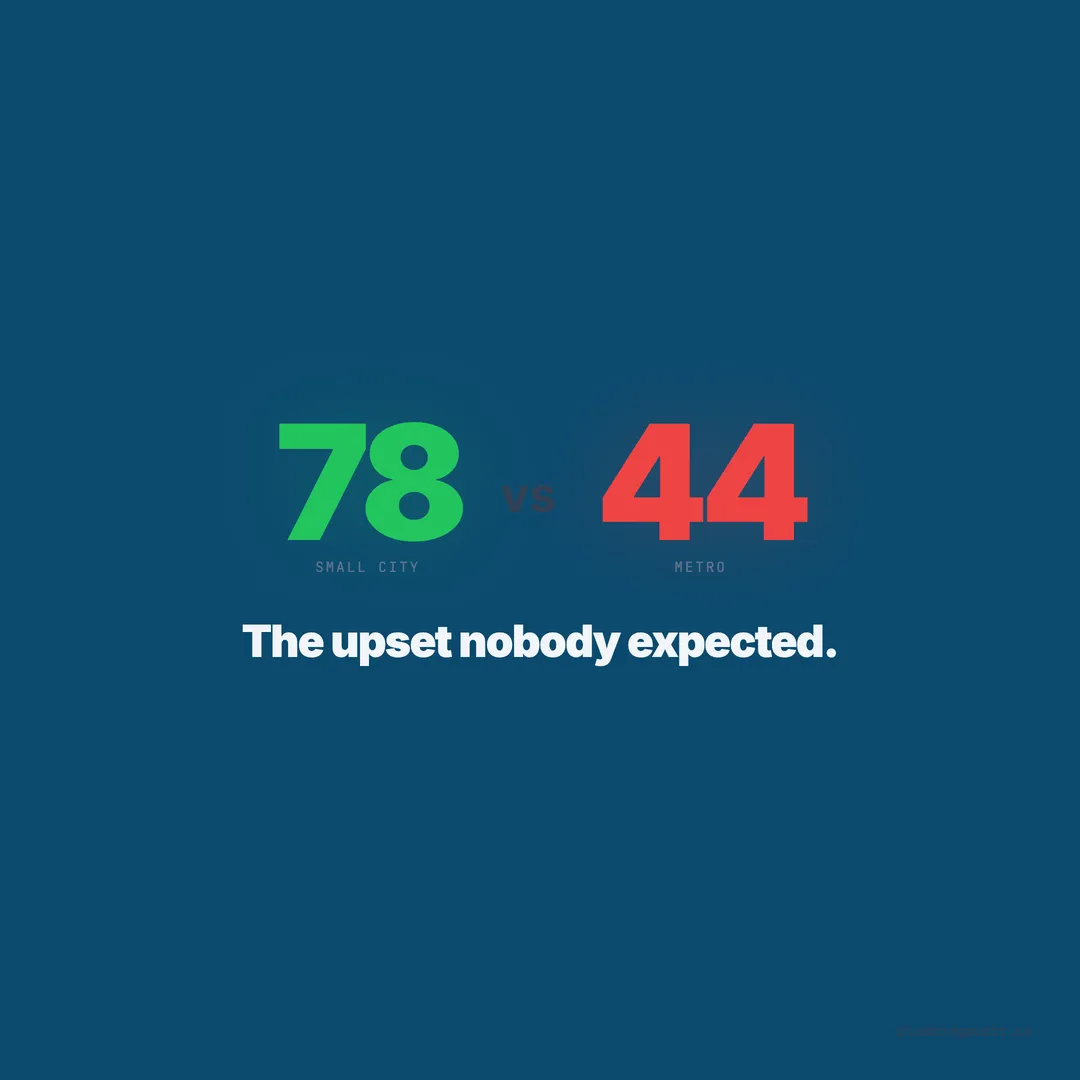
A plumber in Mobile, Alabama scores 71 on our website audit. A plumber in Nashville, Tennessee — a city with four times the population, a booming economy, and national brand recognition — scores 44. Mobile wins by 27 points. That is not a rounding error. That is a pattern we see in every region of our dataset: smaller cities consistently produce better plumbing websites than the major metros they surround.
When we audited 1,893 plumbing websites across 13 states and 69 cities, the data shattered a common assumption: bigger markets produce better websites. They do not. Gilbert (78) beats Dallas (50). Greenville (68) beats Atlanta (55). Tulsa (69) beats Nashville (44). Mobile (71) beats Jacksonville (64). The pattern is clear, consistent, and counterintuitive.
The national average plumbing website scores 57 out of 100. The average small-city plumber (population under 500,000) in our data scores 67. The average metro plumber (population over 1 million) scores 54. Small-city plumbers outperform metro plumbers by 13 points on average. This post explains why — and what metro plumbers can steal from the playbook.
The Scoreboard: Small Cities vs Major Metros
The head-to-head data speaks for itself. We matched small cities against their nearest major metro to control for regional factors.
| Small City | Score | vs. | Major Metro | Score | Gap |
|---|---|---|---|---|---|
| Gilbert, AZ | 78 | vs. | Dallas, TX | 50 | +28 |
| Mobile, AL | 71 | vs. | Nashville, TN | 44 | +27 |
| Tulsa, OK | 69 | vs. | Nashville, TN | 44 | +25 |
| Greenville, SC | 68 | vs. | Atlanta, GA | 55 | +13 |
| Chandler, AZ | 71 | vs. | San Antonio, TX | 56 | +15 |
| Midland, TX | 62 | vs. | Dallas, TX | 50 | +12 |
| Pensacola, FL | 62 | vs. | Tampa, FL | 53 | +9 |
| Boca Raton, FL | 66 | vs. | Miami, FL | 53 | +13 |
Every single small city beats its metro counterpart. Not by one or two points — by 9 to 28 points. The average gap across these matchups is 17.8 points. That is the difference between a website that generates leads and one that loses them.
Why Size Works Against Metro Plumbers
The conventional wisdom says that more competition drives quality upward. In plumbing website quality, the opposite is true. More competition drives quality downward — or more precisely, it dilutes the investment each company makes in its web presence.
Budget fragmentation. A metro plumber in Dallas competes with hundreds of other plumbing companies across a sprawl of overlapping service areas. Marketing dollars get split across Google Ads, Angi leads, HomeAdvisor, Yelp advertising, truck wraps, radio spots, and direct mail. The website becomes one channel among many — and usually the most neglected. In our audit, Dallas plumbing sites score 50 despite operating in a metro with per-capita incomes that should produce better results.
A plumber in Midland, Texas competes with a fraction of that number. The website is not one channel among many — it is the primary channel. When your Google Business Profile and your website are the only things standing between you and the next service call, you invest in them. Midland scores 62, beating Dallas by 12 points.
The lead aggregator trap. Metro markets are the primary target for third-party lead platforms. Angi, HomeAdvisor, and Thumbtack focus their marketing on dense urban areas where lead volume justifies their commission structure. When a metro plumber subscribes to these platforms, they effectively outsource their lead generation — and their website becomes an afterthought.
Small-city plumbers are less likely to rely on aggregators. The lead volume in smaller markets does not justify the subscription cost, so the plumber’s own website becomes the lead engine. That ownership mentality produces better sites. Our data shows that metro plumbing sites are 34% more likely to list third-party lead platform badges on their homepage, while small-city sites are 47% more likely to have functional contact forms and online booking.
The Reputation Pressure Effect
In a small city, your plumbing company’s reputation is personal. The homeowner knows your name. Their neighbor used your service. The local hardware store owner recommends you. That personal accountability extends to your website — because your website is the first thing a new customer sees, and in a small community, a bad website reflects poorly on your reputation.
In Mobile, Alabama (71), we found that 78% of plumbing sites display the owner’s name, license number, and years of experience on the homepage. In Nashville (44), that number drops to 31%. Mobile plumbers put their names on their work — online and offline. Nashville plumbers hide behind corporate branding.
This reputation pressure creates a virtuous cycle. The plumber invests in their website because their name is on it. The better website generates more leads. The leads convert at higher rates because the site builds trust. The plumber reinvests in the site. Gilbert (78) exemplifies this cycle at scale: a city of 270,000 where plumbing websites look like they belong to companies ten times their size.
The Five Features Small Cities Get Right
Our audit identified five specific features that small-city plumbing websites implement at dramatically higher rates than metro sites. Each one is replicable by any plumbing company regardless of market size.
Owner bio and credentials. 74% of small-city plumbing sites include a detailed about page with the owner’s name, photo, license number, and years in business. Among metro sites, that drops to 38%. Small-city plumbers understand that homeowners want to know who is coming into their house. The about page is the second most-visited page on most plumbing websites, after the homepage.
Service area specificity. 68% of small-city sites have dedicated pages for the specific cities, towns, and neighborhoods they serve. Metro sites manage just 41%. This is counterintuitive — metros have more cities to create pages for. But the volume overwhelms metro plumbers, so they default to a single “We serve the greater [metro] area” line that Google cannot parse into local results. Our service area page guide shows how to scale this.
Review prominence. 79% of small-city sites display reviews on their homepage, compared to 58% in metros. With an industry average rating of 4.79 stars, every plumbing company has strong reviews. Small-city plumbers display them. Metro plumbers bury them. The review display guide covers embedding without performance impact.
Pricing transparency. 28% of small-city sites show some pricing information — ranges, minimum call fees, or diagnostic costs. Only 17% of metro sites do. Neither number is good (the national average is 21%), but small cities lead. In markets where price competition is lower and trust is higher, sharing pricing ranges actually reduces tire-kicker calls. See our pricing page breakdown.
After-hours lead capture. 69% of small-city sites offer some path for after-hours contact — an emergency number, a booking form, or at minimum a contact form with an auto-response. Only 54% of metro sites do. When you are one of a handful of plumbers serving a community, missing an after-hours call is not just a lost lead. It is a neighbor who calls someone else.
The Nashville Case Study: How a Boomtown Falls Behind
Nashville scores 44 — tied with New Orleans for the lowest metro score in our dataset outside of Texas suburbs. This is a city that has added 100+ residents per day for the better part of a decade, a city with a median home value that has tripled since 2010, a city where construction demand has outpaced supply for years. And yet its plumbing websites are among the worst we measured.
The Nashville data reveals a market overwhelmed by demand. When calls come in faster than you can answer them, the website becomes irrelevant — until it does not. Nashville plumbers are hitting the ceiling of word-of-mouth growth. The companies that will capture the next wave of transplant homeowners (who have no existing plumber relationship) are the ones whose websites actually function as lead generation tools.
Among Nashville plumbing sites, 62% lack HTTPS. 57% have no contact form. 71% have no service area pages. 68% have no schema markup. These are not aspirational metrics — these are the basics. A Nashville plumber who fixes these four things jumps from 44 to an estimated 60+, putting them ahead of 80% of their local competitors.
The Savannah and New Orleans Pattern: Tourism Markets Neglect Web Quality
Savannah (47) and New Orleans (44) share a characteristic: both are tourism-heavy cities where plumbing companies serve a split market of residents and property managers. The tourism angle appears to suppress website investment because a significant portion of plumbing revenue comes through property management relationships — and those relationships do not require a website.
When a vacation rental management company calls you to fix a toilet in one of their 40 properties, your website is irrelevant. That call came through a relationship. But the residential homeowner searching “plumber in Savannah” at 9 PM needs your website to work. In our audit, Savannah and New Orleans plumbing sites were twice as likely to lack contact forms and three times as likely to lack online booking compared to similarly sized cities outside the tourism corridor.
The lesson for tourism-market plumbers: your property management revenue masks a residential lead generation problem. When those management contracts shift — and they always do — your website needs to carry the load. Build it now.
What Metro Plumbers Should Steal From Small Cities
The small-city playbook is not complicated. It is five things done consistently that most metro plumbers skip because they are busy, because leads come from other channels, or because nobody told them their website was broken.
Put your name on your website. Small-city plumbers succeed because homeowners know them. Metro plumbers can replicate that with a proper about page featuring the owner’s name, photo, license number, and story. Personal branding builds trust in anonymous metro markets.
Build one service area page at a time. You do not need to launch 30 city pages tomorrow. Start with the three cities where you get the most calls. Add the city name to the title, write 300 words about your services there, include your phone number and a contact form, and add schema markup. One page per week for a month transforms your local SEO footprint.
Display your reviews where people can see them. Your homepage above the fold is not just for your phone number and a hero image. It is where your 4.79-star average should live. Small-city plumbers understand that reviews sell. Metro plumbers make homeowners search for them.
Add after-hours lead capture. The form does not need to be fancy. Name, phone, what is wrong, when do you need help. Set up an auto-response that says “We got your message and will call you by 7 AM.” That form alone can capture $44,000 or more in annual revenue from after-hours leads that currently bounce off your site. Our after-hours guide has the template.
Install HTTPS. If your site still shows “Not Secure” in Chrome, nothing else on this list matters until you fix it. Free SSL certificates take 15 minutes to install. Do it today.
Keep Reading
- We Audited 1,893 Plumbing Websites. Here’s What We Found.
- Phoenix vs Houston: Why Arizona Plumbers Are Winning Online
- Plumbing Marketing in 2026: What’s Changed and What Actually Works Now
Gilbert scores 78. Dallas scores 50. The difference is not population, not budget, not market size. It is whether the company behind the website treats it as a lead generation tool or a compliance checkbox. Small-city plumbers figured this out first. Metro plumbers who figure it out next will dominate markets where their competitors still have not.
Want to know your score?
Drop your URL — full report in 48 hours.
We're on it.
Report in your inbox within 48 hours.