Plumbing Websites in Texas: Why the Biggest Market Scores the Lowest
We audited 466 Texas plumbing websites. The avg score is 54/100 — below the national 57. City-by-city data from Sugar Land (28) to Houston (68).
A plumbing company in Arlington, Texas scores 65 on our website audit. Thirty miles east, a plumber in Irving scores 40. Drive south to Sugar Land and the score drops to 28 — the lowest city average in our entire national dataset. All three operate in the Dallas-Fort Worth-Houston corridor, the most competitive plumbing market in the country. All three compete for homeowners willing to spend $445 or more per service call. The difference is not demand — Texas has plenty of that. The difference is what happens when a homeowner lands on their website.
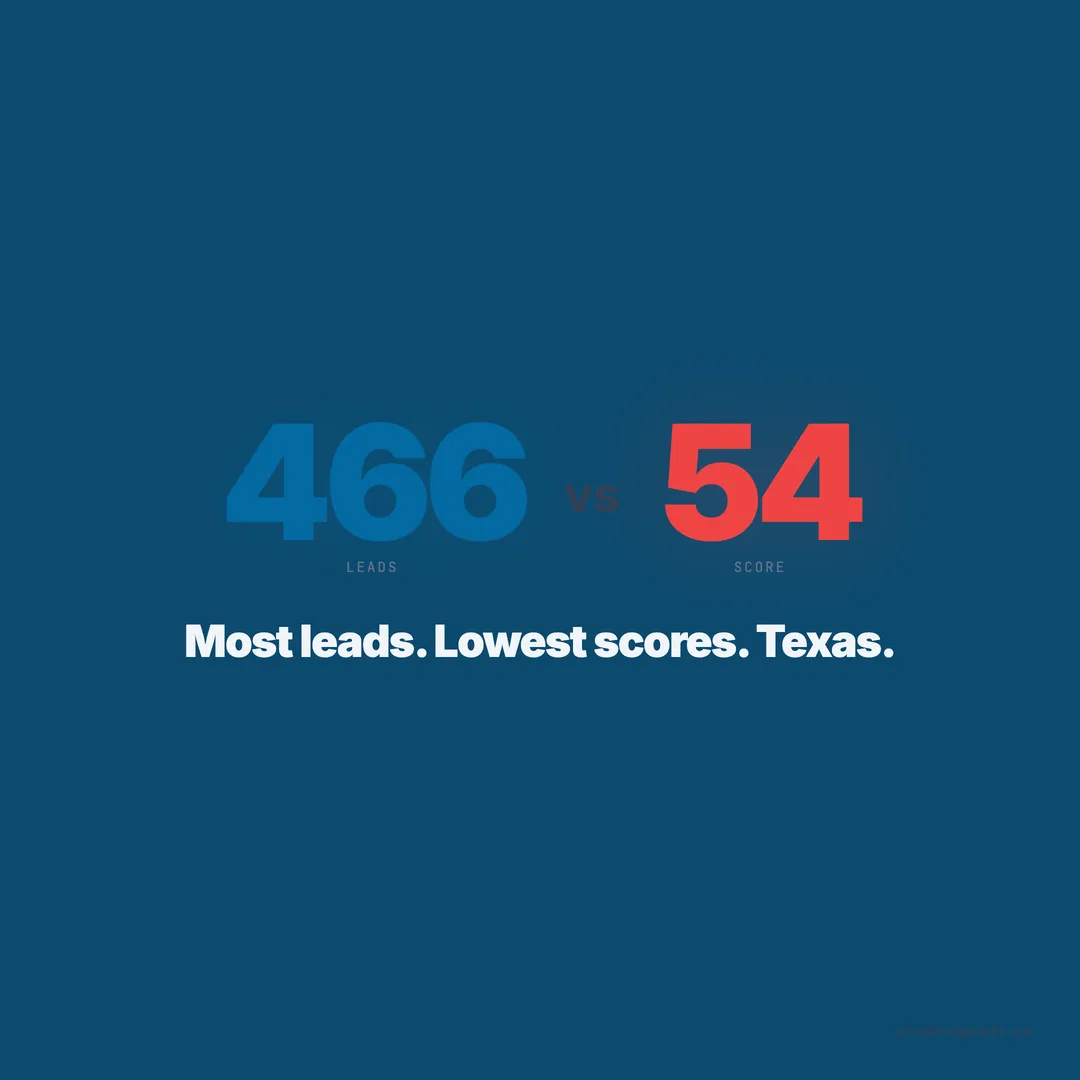
Texas contributes 466 plumbing websites to our audit — the largest single-state sample across 13 states and 1,893 total sites. It employs 42,290 plumbers, second only to California. Licensing exam volume has surged 111% since 2022, jumping from 4,953 exams to 10,447 in 2024. The market is expanding faster than any other state we tracked. And yet Texas plumbing websites average just 54 out of 100 — three points below the national average of 57.
This is the paradox of Texas plumbing: the biggest market, the fastest growth, and the weakest digital presence.
The 23-City Breakdown: Where Every Texas Market Stands
We audited plumbing websites in 23 Texas cities. The spread from top to bottom is 40 points — Houston at 68 to Sugar Land at 28. That gap is wider than the spread between the best and worst states in our national data.
| City | Score | Gap vs. State Avg |
|---|---|---|
| Houston | 68 | +14 |
| Arlington | 65 | +11 |
| Plano | 64 | +10 |
| Midland | 62 | +8 |
| Frisco | 59 | +5 |
| Austin | 58 | +4 |
| Fort Worth | 57 | +3 |
| Round Rock | 57 | +3 |
| League City | 57 | +3 |
| San Antonio | 56 | +2 |
| Corpus Christi | 56 | +2 |
| Pearland | 56 | +2 |
| El Paso | 53 | -1 |
| Georgetown | 53 | -1 |
| McKinney | 52 | -2 |
| Dallas | 50 | -4 |
| Denton | 50 | -4 |
| Katy | 49 | -5 |
| Conroe | 48 | -6 |
| New Braunfels | 41 | -13 |
| Irving | 40 | -14 |
| The Woodlands | 35 | -19 |
| Sugar Land | 28 | -26 |
The data tells three stories: Houston stands alone as a competitive outlier, the DFW suburbs are wildly inconsistent, and the Houston suburbs are some of the worst-scoring markets in the country.
Houston (68): The Exception That Proves the Rule
Houston is the brightest spot in Texas plumbing web quality. At 68, it matches Greenville, SC and Mesa, AZ — cities in states that score 10+ points above Texas overall. Houston plumbers compete in a metro of 7.1 million people where a single zip code can support a dozen plumbing operations. That density forces differentiation.
What Houston plumbers do that the rest of Texas does not: 72% of Houston plumbing sites use HTTPS, compared to just 38% statewide. 61% have contact forms versus the state average of 48%. And 44% display their license number — still below where it should be, but well above the Texas norm of 34%.
Houston’s plumbing market benefits from catastrophic demand cycles. The city’s flooding history — from Hurricane Harvey to seasonal storm surges — means homeowners actively search for plumbers with emergency pages and after-hours availability. That demand pressure has pushed Houston plumbers to build better websites than their peers in calmer markets.
The DFW Inconsistency: 15-Point Swings Within the Same Metro
Dallas-Fort Worth is a single metro area, but the website quality swings wildly. Arlington scores 65. Plano hits 64. Frisco reaches 59. But Dallas itself only manages 50, Denton matches at 50, and Irving drops to 40. These cities share overlapping service areas, the same customer base, and the same competitive landscape. The gap is entirely about whether each company invested in their digital presence.
The pattern suggests that suburban plumbing companies in DFW rely on word-of-mouth and yard signs more than their websites. In a metro approaching 8 million people, that strategy has a ceiling. When 78% of consumers research plumbing companies online before calling, a website scoring 40 is not just underperforming — it is actively turning away customers who found you through search.
Dallas at 50 is particularly notable. It is the ninth-largest city in the United States, anchoring one of the fastest-growing metros in the country. Yet its plumbing websites score 18 points below Houston and 4 points below the national average. The sites we reviewed in Dallas were more likely to be missing service area pages, schema markup, and HTTPS than their Houston counterparts.
The Houston Suburbs: Where Web Quality Goes to Die
Sugar Land (28), The Woodlands (35), Katy (49), Conroe (48), and Pearland (56). Five Houston suburbs, five below-average scores, and a 28-point gap between Pearland and Sugar Land that defies logic. These suburbs collectively serve some of the wealthiest zip codes in Texas. Median household income in Sugar Land exceeds $115,000. The Woodlands tops $130,000. These are homeowners who will pay for quality work. They also expect quality websites.
What we found in Sugar Land is a concentration of plumbing websites that fail at the most basic level. Zero HTTPS adoption in several cases. No contact forms. No online booking. No service descriptions beyond a bulleted list. Several sites were single-page templates with nothing more than a phone number and a stock photo of a wrench. In a market where the average service call exceeds $445, these companies are leaving thousands on the table.
The Woodlands at 35 shares the same pattern: affluent homeowners, strong demand, and websites that look like they were built in 2014 and never updated. Our website checklist covers every element these sites are missing.
What Texas Plumbers Are Missing That Other States Are Not
We compared Texas’s gap percentages against our national averages to identify where the state diverges. The results highlight four areas where Texas plumbing websites underperform the rest of the country.
No HTTPS: 68% of Texas plumbing sites lack HTTPS, compared to 60% nationally. Texas is 8 points worse than the national average on the most basic security measure. Chrome marks these sites “Not Secure” — an immediate trust killer. The fix takes 15 minutes.
No service area pages: 62% of Texas sites have no dedicated location pages, versus 53% nationally. In a state with 23 audited cities spanning a geographic footprint the size of France, service area pages are not optional. A plumber in Katy who does not have a Katy page is invisible to anyone searching “plumber in Katy.” Build the pages. We show you how in our service area page guide.
No license display: 57% of Texas sites skip the license number, compared to 48% nationally. Texas licensing exams have surged 111% since 2022. The state is producing more licensed plumbers than ever, and most of them are not putting their credentials on their website. That is a missed trust signal in a state where the licensing board is actively expanding.
No schema markup: 56% of Texas sites lack structured data, versus 47% nationally. Schema tells Google what your business does, where you operate, and what customers think of you. Without it, you are relying on Google’s best guess — and Google’s best guess is rarely favorable when you are competing against 466 other Texas plumbing websites.
Austin and San Antonio: The Underperforming Tech Hubs
Austin scores 58 — four points above the state average but nine points below the national top performers. For a city known as a technology hub with a population approaching 2.5 million in the metro area, that number is underwhelming. San Antonio scores 56, two points above the state average but still firmly in mediocre territory.
Both cities share a common issue: an over-reliance on third-party lead generation platforms like Angi and HomeAdvisor instead of investing in owned web properties. When plumbing companies funnel their marketing budget into lead aggregators rather than their own websites, the sites atrophy. The pages stop getting updated, the content goes stale, and the scoring fundamentals — forms, schema, HTTPS — never get addressed.
Round Rock (57) and Georgetown (53) reflect the Austin metro pattern. These are growing suburban markets where new plumbing companies are launching regularly, often with template websites that check none of the boxes our audit measures. A fresh template on Wix or GoDaddy starts with a score near 30 unless the company invests time in configuring it properly.
The Midland Surprise: West Texas Scores Higher Than Dallas
Midland scores 62 — 12 points above Dallas, 8 points above the state average, and competitive with Florida’s best cities. This is a West Texas oil town with a fraction of Dallas’s population. What explains it?
Competition density. Midland has fewer plumbing companies per capita, which means each company takes its web presence more seriously. When there are only a handful of plumbers serving a metro, every lead matters. That pressure produces better websites — more complete about pages, better trust signals, and more consistent use of structured data.
The same pattern appears nationally: smaller markets often outperform larger ones. We documented this in our analysis of why small-city plumbers outscore metro competitors. Midland is the Texas case study for that trend.
What Texas Plumbing Companies Should Do Now
The data points to a clear action plan for Texas plumbers. The state’s weaknesses are specific, measurable, and fixable — none of them require a full website redesign.
Install HTTPS immediately. This is the single highest-impact change. It removes the “Not Secure” warning, improves your search ranking signal, and lifts your audit score by 8-12 points on its own. Every major hosting platform offers free SSL certificates. Our security fix guide walks through the process.
Add service area pages for every city you serve. If you work in five cities, you need five pages. Each page should include the city name in the title, a paragraph about your services in that area, and your Google Business Profile data for that location. This is how you rank for “plumber in [city]” searches.
Display your license number. Texas requires plumbing licenses. You earned yours. Put it in your footer, on your about page, and in your schema markup. It takes less than a minute and signals legitimacy to both homeowners and search engines.
Add schema markup. At minimum, add LocalBusiness schema with your name, address, phone, hours, service area, and aggregate rating. Our schema guide has the JSON-LD code you can copy directly into your site.
Keep Reading
- We Audited 1,893 Plumbing Websites. Here’s What We Found.
- Phoenix vs Houston: Why Arizona Plumbers Are Winning Online
- Why Small-City Plumbers Are Outscoring Metro Competitors
Texas has the plumbers, the demand, and the customers willing to pay. What it does not have — yet — is the websites to match. The companies that fix these gaps first will capture the leads that everyone else is leaving behind. In a market of 466 competitors, that head start is worth everything.
Want to know your score?
Drop your URL — full report in 48 hours.
We're on it.
Report in your inbox within 48 hours.