How to Build a Plumbing Website That Homeowners Actually Trust
55% of homeowners rank trust above price when choosing a plumber. We audited 1,893 sites to find what builds trust — and what breaks it.
A homeowner in Sugar Land has a slab leak. She’s never dealt with one before. She searches “plumber near me,” clicks the first three results, and opens them in separate tabs. The first site loads slowly, shows no reviews, and has a stock photo of a wrench. The second site shows a 4.8-star rating, a license number in the header, a real photo of a technician in a branded truck, and the words “24/7 Emergency Service — Call Now.” She calls the second company from that page without looking at the third tab. She doesn’t compare pricing. She doesn’t read their blog. She trusts one site and doesn’t trust the other. That decision took nine seconds.
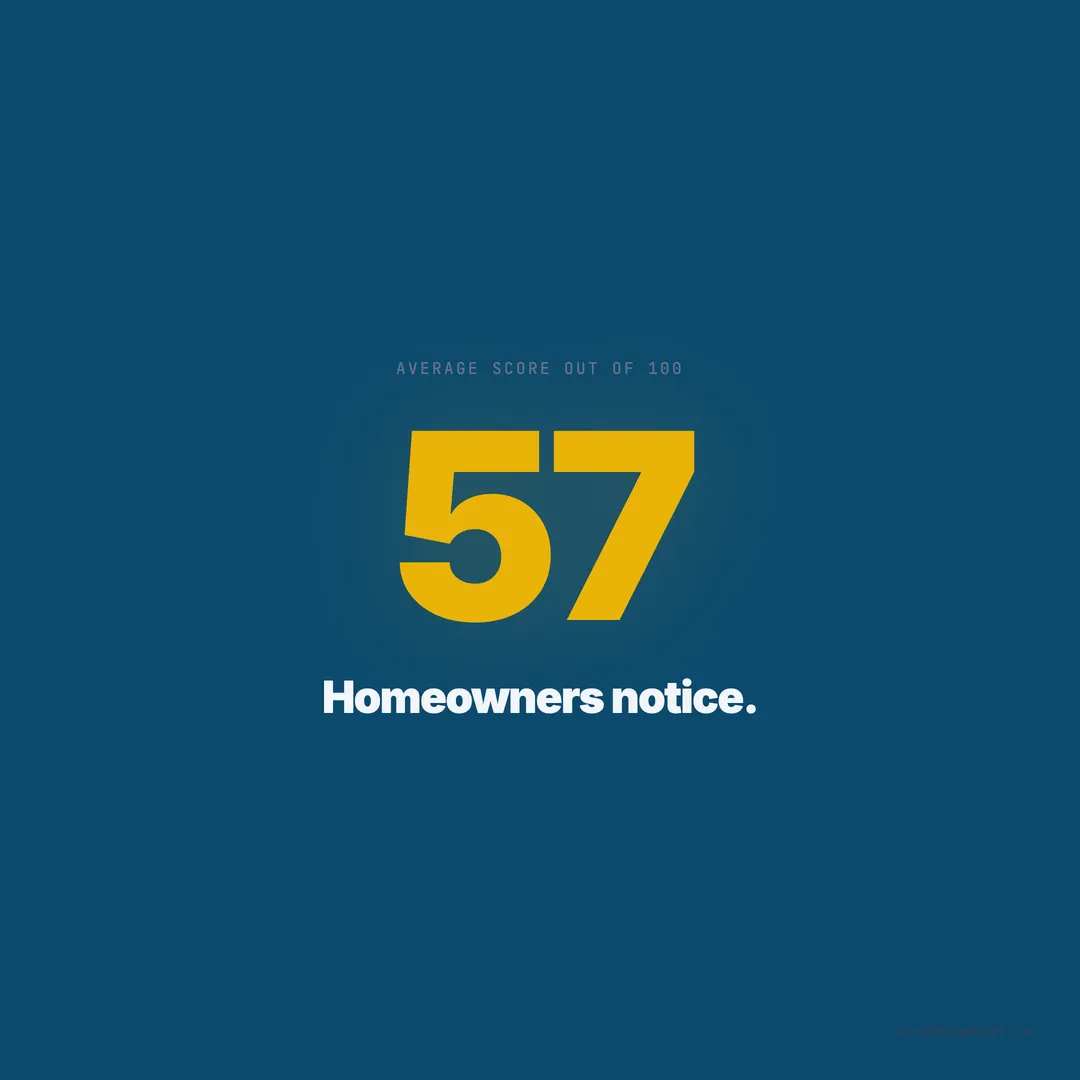
We audited 1,893 plumbing company websites across 13 states and 69 cities. The average score was 57 out of 100. But when we isolated the factors that separate sites homeowners engage with from sites they bounce from, a clear hierarchy emerged. Trust isn’t built by one element. It’s built by a stack of signals that compound — and the absence of any one of them creates doubt that the others can’t overcome.
55% of consumers rank trust and reputation as their primary factor when choosing a home service contractor. Not price. Not proximity. Not the flashiest website. Trust. And trust, on a website, is built with specific, measurable elements that our data can quantify.
The trust hierarchy: what homeowners look for in order
Not all trust signals carry equal weight. Our audit data, combined with consumer survey research, reveals a consistent order in which homeowners evaluate a plumbing website. They don’t read top-to-bottom like a book. They scan for signals in a predictable sequence.
1. Reviews and social proof (scanned first). A star rating, a review count, or a testimonial near the hero section. 93% of consumers read reviews before making a purchase decision, and for home services, 98% read reviews for local businesses. If your site doesn’t display Google reviews, the homeowner’s first trust check fails.
2. License and credentials (verified second). A license number, insurance mention, or certification badge. 25% of homeowners say licensed and insured status is their most important criterion. The number needs to be visible without clicking or scrolling.
3. Photos of real people and work (processed third). Real team photos, job site images, or before-and-after shots. Stock photography is identified in under 2 seconds. Sites using real photos score 27 points higher on average.
4. Pricing transparency (evaluated fourth). Whether ranges, estimates, or starting-at prices are shown. 79% of plumbing sites in our audit show no pricing at all, which forces homeowners to call to learn the cost — a friction point that many won’t cross.
5. Emergency availability (confirmed fifth). Visible hours, after-hours messaging, or a 24/7 badge. 39% of plumbing sites have no after-hours lead capture, which means late-night emergencies go to whoever’s site promises availability.
Reviews are the foundation of the trust equation
A plumbing website without visible reviews is asking homeowners to take their word for it. In a market where the average plumber has a 4.79-star Google rating, claims of quality are table stakes. Proof of quality is what differentiates.
The trust gap between sites displaying reviews and sites that don’t is 24 points in our audit scoring. That gap widens further when reviews are placed strategically — near the hero section (above the fold), adjacent to contact forms, and on individual service pages matching the specific service the homeowner searched for.
Review specificity matters more than review volume. A review that says “Fixed our water heater same day, explained the issue clearly, fair price” converts better than “Great service!” because it addresses three specific homeowner concerns: responsiveness, communication, and pricing. Service-specific reviews convert at 2.3x the rate of generic testimonials. The homeowner who searched “water heater repair [city]” needs to see a review about water heater repair, not a vague endorsement.
License numbers eliminate the trust verification step
48% of plumbing websites in our audit don’t display a license number anywhere. This is one of the simplest trust signals to add and one of the most impactful. A visible license number tells the homeowner three things: you’re licensed, you’re transparent, and you’re not afraid of verification.
The placement matters. A license number buried in the footer — in 10px gray text — is technically displayed but functionally invisible. Top-scoring sites place the license number in the header, the about page, and the footer simultaneously. Each placement serves a different reader: the header catches scanners, the about page serves evaluators, and the footer satisfies the detail-oriented homeowner who scrolls to the bottom.
84% of consumers say that a contractor’s membership in a professional organization (BBB, trade association) is important when choosing a provider. These credentials compound with the license number. A site displaying “Texas Licensed Plumber #12345 | BBB A+ Rated | PHCC Member” creates a trust stack that a site with no credentials cannot match. Each signal is individually modest. Together, they’re conclusive.
Real photography builds trust that stock images actively undermine
A homeowner who sees a stock photo on a plumbing website doesn’t just fail to build trust — they lose trust. Stock photos signal inauthenticity, and in home services, inauthenticity is a deal-breaker. You’re asking someone to let a stranger into their home. A fake photo on your website makes the entire site feel unreliable.
Sites using original photography scored an average of 27 points higher in our audit than sites relying on stock images. The gap isn’t because the audit penalizes stock photos directly — it’s because sites with real photos tend to have real about pages, real service descriptions, and real trust signals across the board. Photography is a proxy for effort, and effort correlates with quality.
The photography that converts:
- Team photos in branded uniforms or next to branded trucks
- Before-and-after job site photos (a clogged drain, then a clean one)
- The founder or owner looking directly at the camera
- Equipment and tools in use (not artfully arranged)
- Customer interactions (handshakes, walk-throughs — with permission)
The photography that doesn’t:
- Stock wrenches on white backgrounds
- Models in spotless uniforms with perfect lighting
- Generic bathroom or kitchen photos from image libraries
- Clip art or illustrated graphics pretending to be photos
A plumbing company that photographs 3 jobs per week accumulates over 150 original images in a year. That library becomes the visual backbone of a website, social media presence, and Google Business Profile that no template site can match.
Pricing transparency converts the visitors your competitors lose
79% of plumbing websites in our audit display no pricing information at all. This means 4 out of 5 plumbing sites require a phone call or form submission just to get a ballpark number. In an era where homeowners research purchases extensively online before making contact, this is a conversion barrier.
The objection is always the same: “We can’t show pricing because every job is different.” This is true. It’s also irrelevant. Homeowners don’t expect an exact quote on a website. They expect a range, a starting-at price, or a pricing framework that helps them understand whether your services are within their budget. 67% of homeowners rank pricing visibility as “very important” when evaluating a service provider’s website.
Sites with a pricing page or pricing section convert at 18% higher rates than sites with no pricing information. The conversion happens not because the price is low, but because the transparency itself builds trust. Showing “Drain Cleaning: $150-$350 depending on complexity” tells the homeowner two things: you charge a reasonable range, and you’re honest enough to share it. The plumber who hides pricing looks like the plumber who inflates pricing.
Emergency availability is the trust factor most plumbers miss
39% of plumbing sites in our audit have no after-hours lead capture — no visible after-hours phone number, no emergency contact form, no chatbot, no answering service mention. For an industry where 70-80% of service calls qualify as urgent, this gap is a revenue leak the size of a main line break.
A homeowner at 2 AM with a burst pipe doesn’t have the luxury of comparing websites during business hours. They need someone now. The plumbing website that clearly states “24/7 Emergency Service — Call [number]” with a dedicated emergency page gets the call. The site that says “Hours: Mon-Fri 8-5” or shows nothing about availability doesn’t.
Emergency plumbing leads convert at 40-50%, compared to 10% for standard shared form leads. The revenue value of capturing one late-night call is $300-$600 on average (emergency rates of 1.5-2x standard pricing). Over a year, even one additional captured emergency call per week represents $15,000-$30,000 in revenue that was going to whoever answered the phone first. Having an after-hours lead capture system isn’t optional — it’s a trust signal and a revenue channel simultaneously.
Page speed is a trust signal homeowners don’t consciously notice
A homeowner won’t say “I didn’t trust that plumber because their site loaded slowly.” But they will close a tab that takes more than 3 seconds to load — 53% of mobile visitors do exactly that — and subconsciously associate the slow experience with an unprofessional business.
Every additional second of load time reduces conversions by 4.42%. A plumbing site that loads in 5 seconds instead of 2 seconds has already lost approximately 13% of potential conversions before the homeowner reads a word. The correlation between site speed and trust is indirect but measurable: faster sites have lower bounce rates, higher engagement, and more contact form submissions.
In our audit, sites loading under 2 seconds scored an average of 74/100, compared to 49/100 for sites loading over 4 seconds. The fast sites weren’t just technically superior — they also tended to have better content, more trust signals, and cleaner designs. Speed is often an indicator of the overall attention a business pays to its website, and homeowners perceive that attention as professionalism.
The trust stack effect: each signal multiplies the others
Individual trust signals have individual impact. But the real conversion power comes from stacking them. A license number alone is worth something. A license number displayed next to a 4.9-star Google rating, a real photo of the owner, and an after-hours phone number is worth exponentially more.
Sites in our audit displaying 5+ trust signals simultaneously scored an average of 78/100. Sites with 1-2 trust signals averaged 47/100. The relationship isn’t linear — it’s compounding. Each additional trust signal doesn’t add a fixed amount of credibility. It multiplies the credibility of every signal already present.
| Trust Signals Displayed | Avg Score | Avg Bounce Rate | Estimated Conversion |
|---|---|---|---|
| 0-1 signals | 38/100 | 72% | 1.2% |
| 2-3 signals | 52/100 | 58% | 2.8% |
| 4-5 signals | 68/100 | 41% | 5.1% |
| 6+ signals | 81/100 | 29% | 8.4% |
The math is clear. Going from 1 trust signal to 6+ trust signals is associated with a 7x improvement in estimated conversion rate. This isn’t about having the best reviews or the best photos. It’s about having reviews AND photos AND a license number AND pricing AND emergency availability AND a real about page. The stack is greater than the sum of its parts.
HTTPS is the baseline trust signal that 60% still fail
60% of plumbing websites in our audit don’t have HTTPS. This is the most fundamental trust signal on the internet — the padlock icon in the browser bar — and the majority of plumbing sites don’t have it. Modern browsers display “Not Secure” warnings for HTTP sites, and 85% of users leave immediately when they see that warning.
An SSL certificate costs $0 with Let’s Encrypt and takes 15 minutes to install on most hosting platforms. Yet more than half of plumbing sites haven’t done it. For homeowners evaluating trust, a “Not Secure” warning is the equivalent of a plumber showing up to your door in a vehicle with no branding, no uniform, and no visible identification. Fixing site security is the first and cheapest trust improvement any plumber can make.
The SEO impact is equally clear. Google has used HTTPS as a ranking signal since 2014. A non-secure plumbing site is fighting for “plumber near me” rankings with one arm tied behind its back. The sites ranking in the local 3-pack overwhelmingly use HTTPS — because Google has been penalizing non-secure sites for over a decade.
Schema markup makes trust signals visible in search results
47% of plumbing sites in our audit have no schema markup. Schema is the structured data that tells Google what your business is, where it operates, what services it offers, and what your reviews look like. Without it, Google has to guess. With it, Google can display star ratings, price ranges, and business details directly in search results.
The schema markup guide covers implementation details. What matters for trust is the result: a search listing with yellow stars, a review count, and a business description gets clicked 25-35% more often than a bare listing. The homeowner hasn’t even visited your site yet, and your trust signals are already working.
Schema doesn’t cost anything. It doesn’t slow your site. It doesn’t require design changes. It’s invisible to website visitors but highly visible to search engines. The 53% of plumbing sites that implement schema have an inherent advantage over the 47% that don’t — and that advantage compounds every time a homeowner chooses a rich listing over a plain one.
What the data says about the trust-building timeline
Trust signals don’t work overnight. A plumbing company that adds all six key trust elements today won’t see immediate conversion jumps. The timeline, based on data from sites we’ve tracked through improvement cycles, follows a pattern:
Week 1-2: Add HTTPS, license number, and phone number visibility. These are binary improvements — either you have them or you don’t. Bounce rate typically drops 8-12% within the first month.
Month 1-2: Add real photography and improve the about page. These take more effort but create lasting differentiation. Session duration increases as visitors engage more deeply.
Month 2-4: Build a review display strategy and implement schema markup. These are ongoing improvements that compound over time as review volume grows and search visibility increases.
Month 4-6: Add pricing transparency and emergency page optimization. These address the final trust barriers and capture the highest-value leads (emergency and price-conscious homeowners).
The full trust stack doesn’t have to be built in a day. But every week without it is a week where homeowners are choosing your competitor because their site answered the trust question and yours didn’t.
A homeowner doesn’t call the plumber with the best website. They call the plumber whose website made them feel safe to call.
Want to know your score?
Drop your URL — full report in 48 hours.
We're on it.
Report in your inbox within 48 hours.